Author: admin

  • What FDA’s Latest Warning Letter Means for Animal Health Companies Using AI

    What FDA’s Latest Warning Letter Means for Animal Health Companies Using AI

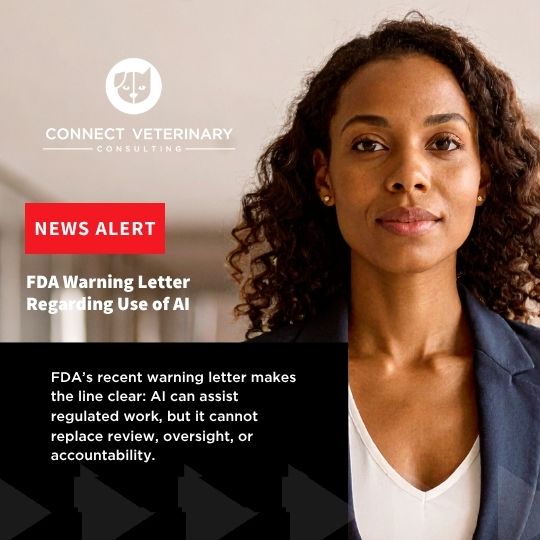
    If you thought AI was something you could hand the wheel to and walk away – FDA just pulled over a company for exactly that.

    A warning letter issued April 2, 2026 to Purolea Cosmetics Lab lays out something regulated companies in every sector need to understand: AI can support compliance work, but it cannot own it. The letter describes a manufacturer that used AI agents to create drug product specifications, procedures, and master production and control records – and then failed to adequately review those documents to confirm they were accurate and actually compliant with CGMP requirements.

    FDA was direct in its response: if AI is used to help with CGMP activities going forward, any output or recommendation from an AI agent must be reviewed and cleared by an authorized human representative of the firm’s quality unit.

    That requirement isn’t a technicality. It’s a reminder of where accountability lives – and it’s not in the software.

    The Moment That Should Stop Every Regulated Leader Cold

    Perhaps the most striking detail in the letter involves process validation. During the inspection, FDA investigators informed the firm that process validation had not been completed before distribution – a legal requirement. The company’s response? They weren’t aware it was required because the AI agent they were using had never told them.

    Let that land for a moment.

    “The AI didn’t tell us” is not a quality system. It is not a compliance strategy. And it would not hold up in front of an inspector, a customer, a veterinarian, or a board of directors.

    In animal health, this matters in a particular way. Our industry runs on clinical trust. The professionals and companies in this space are held to standards by the FDA’s Center for Veterinary Medicine, the USDA, the veterinary community, and animal owners who make decisions based on what we tell them is safe and effective. The accountability structure doesn’t shift because AI helped draft the document.

    AI Is Leverage. It Is Not Leadership.

    None of this means animal health companies should avoid AI. The lesson here isn’t fear – it’s governance.

    AI can be genuinely useful for lean teams navigating complex regulatory environments. It can help organize information, create first drafts, summarize guidance documents, and reduce the administrative burden on technical and regulatory staff. That kind of support has real value, especially in an industry where qualified professionals are stretched thin.

    But there’s a difference between using AI to accelerate expert work and using AI to substitute for it.

    AI can draft a procedure. A qualified person must determine whether that procedure is scientifically sound, accurately reflects the process, and meets regulatory expectations for your specific products and claims. AI can summarize a regulation. A regulatory affairs professional must determine how that regulation applies to your pipeline, your label, your evidence package. AI can generate documentation. A quality unit must review, approve, and own it.

    Speed is one variable in regulated work. It is not the only one.

    The Real Risk Isn’t Using AI – It’s Using It Without Guardrails

    A well-governed AI process can help strong teams move faster. A poorly governed one can make weak systems look polished while the gaps underneath grow quietly larger.

    This is worth saying plainly for animal health companies that are actively integrating AI into marketing, regulatory submissions, technical service content, veterinary education materials, or product launch planning: the output may look complete before the thinking is sound. It may look compliant before a qualified human has verified it is. That is a different kind of risk than most teams are used to managing, because it doesn’t always look like a risk at first.

    The strongest organizations won’t be the ones using AI in the most places. They’ll be the ones who have thought clearly about where AI belongs, where it doesn’t, and who is responsible for every decision that reaches a customer, a clinician, or a regulator.

    The bot can help draft. The expert still has to sign off.

    Is Your Team Clear On Where The Line Is?

    If you’re using AI across regulatory, technical, marketing, or quality-adjacent workflows – now is a good time to map where human review is required and who owns the final output. Connect Veterinary Consulting helps animal health companies build communication and compliance strategies that are as rigorous as they are effective. Book a free consultation at the link below to talk through what this means for your team.

  • The CVS Effect in Veterinary Medicine

    What happens when consolidation shifts bargaining power?

    Consolidation changes ownership. It also changes leverage.

    In the early stages of consolidation, labor tends to win. Signing bonuses rise. Compensation climbs. Recruiters compete aggressively. Narratives of shortage dominate.

    Veterinary medicine has been in that phase for several years.

    But consolidation follows predictable cycles. And so do labor markets.

    As consolidation increases and labor supply expands, bargaining power shifts – from clinician to operator. The shift is rarely ideological. It is arithmetic.

    We have seen this pattern before.

    When CVS Health accelerated acquisitions, it entered fragmented markets, attracted pharmacists with competitive compensation, and expanded its geographic footprint rapidly. Early on, labor leverage was strong.

    Over time, independent alternatives narrowed. Market density increased. Optionality compressed.

    Bargaining power recalibrated.

    Similarly, in vertically integrated health systems such as UnitedHealthcare – where insurance, care delivery, and infrastructure operate within a unified ecosystem – labor markets behave differently once capital controls multiple layers of the value chain.

    Veterinary medicine is not pharmacy. It is not human healthcare.


    Read the Full Analysis…

    Veterinary consolidation has reshaped the profession over the past decade, driving higher compensation, increased competition for talent, and expanded corporate investment across the industry.

    But consolidation cycles evolve. As ownership concentrates and labor supply expands, the bargaining power dynamics that fueled rapid salary growth begin to shift.

    This article explores how veterinary consolidation changes leverage within the profession—and why the durability of today’s compensation models may become a central question for operators, investors, and clinicians alike.

    >> READ FULL ARTICLE

  • Veterinary Consolidation: Shifting Salary Leverage

    Veterinary Consolidation: Shifting Salary Leverage

    Independent veterinary practices are not facing a valuation crisis.

    They are facing something more subtle—and potentially more dangerous.

    Across the industry, headline valuations remain resilient. Buyer interest persists. Capital is still available. On the surface, the market appears stable.

    Yet underneath that stability, a quieter shift is taking place—one that does not show up immediately in revenue reports, but becomes unmistakable during diligence, underwriting, and strategic review. The key risk factors include declining client retention, higher labor costs, greater earnings variability, and a changing client mix that affects margins and predictability.

    The threat is not declining demand in the abstract. The key risk lies in the deterioration of earnings quality and predictability, driven by changes in client retention, demand structure, and the efficiency with which demand is converted into durable cash flow.

    This erosion rarely announces itself. It accumulates.

    When Revenue Looks Stable but Becomes Less Reliable

    Many independent practices still report solid topline numbers. What has changed is how those numbers are generated.

    Key risk factors have emerged: visit frequency is softening, transaction values are more volatile, client mix is shifting toward higher-maintenance, lower-margin segments, labor costs are structurally higher and less flexible, and capacity constraints increasingly dictate which services can be delivered rather than strategic intent.

    None of this necessarily collapses revenue in the near term.

    But it does introduce variability—and variability is the enemy of enterprise value.From an executive perspective, the issue is not whether revenue exists today. It is whether that revenue is repeatable, transferable, and resilient under different ownership, staffing, and animal health market conditions.


    Read the Full Analysis…

    Veterinary consolidation has accelerated over the past decade, bringing capital access, operational scale, and career mobility across corporate networks. At the same time, associate compensation has risen meaningfully, driven by competition and persistent shortage narratives.

    But consolidation cycles mature. Labor markets adjust. And compensation structures that were built during high-growth acquisition phases are not always structurally durable over the long term.

    This analysis examines how veterinary consolidation reshapes bargaining power, workforce optionality, and long-term economic resilience within the profession.

    >> READ FULL ARTICLE

  • Connect Veterinary Consulting Announces New Service Offering

    [vc_row][vc_column][vc_column_text css=””]

    Connect Veterinary Consulting Launches Strategic Whiteboarding Session
    New Service Helps Veterinary and Pet Brands Align Strategy, Messaging, and Growth Plans


    Kansas City, Missouri (July 7, 2025). Connect Veterinary Consulting, a leading veterinary marketing strategy firm, announces the launch of a new service offering: a focused 2-hour virtual whiteboarding session designed to help pet, vet, and animal health brands clarify their marketing strategy and move forward with confidence.

    This service was created in response to growing demand from early-stage startups, growth-phase brands, and commercial leaders who are navigating a complex and evolving animal health landscape.

    “Many of the brands we work with are stuck in what I call ‘strategy limbo,’” said Dr. Meghan Burns, DVM, President of Connect Veterinary Consulting (Connect VC). “They have good ideas, great products—but they’re missing alignment between teams, or clarity on how to actually go to market. This session is a high-impact way to fix that quickly.”

    During the virtual session, participants work one-on-one with Dr. Burns to tackle key business challenges such as:


      • Build/refine a go-to-market strategy


      • Align product, marketing, and sales teams


      • Clarify brand messaging and positioning


      • Unlock stalled growth or market entry


    Unlike generic workshops or templated audits, each session is personalized to the client’s business needs and draws on Connect VC’s deep experience across companion animal, diagnostics, therapeutics, devices, and beyond.


    [/vc_column_text][/vc_column][/vc_row]

  • Getting Started with Marketing for Your Veterinary Practice

    Getting Started with Marketing for Your Veterinary Practice

    Today, we want to help your veterinary practice take its first steps into the world of marketing. Whether you’re a seasoned pro or just starting out, there’s something here for everyone.

    Leveraging the Power of Marketing

    Digital marketing has revolutionized the way businesses connect with their audience. As a veterinary clinic, you have the potential to reach a wide audience, but it’s essential to harness this power effectively within your local community.

    Blending Traditional & Digital Marketing

    A winning strategy often involves blending traditional and digital marketing approaches. Did you know that 45% of small businesses use this mix to reach their audience effectively? This approach acknowledges the importance of meeting your clients where they are – both online and offline.

    Your First Steps in Veterinary Marketing

    Now that you’re considering your marketing strategy, let’s focus on a few essential points:

    1. Consistency

    Effective marketing relies on consistency in brand voice, tone, and visual identity. It’s also about maintaining a regular publishing schedule. For instance, if you release a monthly newsletter, sticking to the same schedule helps clients know what to expect from you. Consistency not only builds trust but also provides valuable data to assess your marketing efforts.

    2. Data-Driven Decisions

    To make your marketing efforts count, you need to understand what works and what doesn’t. Whether you’re delving into pay-per-click ads or doubling down on SEO, having the right tracking software in place is crucial. Analyzing this data allows you to refine your marketing plan for better results as you progress.

    We hope these insights give you a solid foundation for embarking on your veterinary marketing journey. Whether you’re aiming to expand your reach or strengthen your local presence, a well-thought-out marketing strategy can make all the difference.If you have any questions or need further guidance, please don’t hesitate to reach out to us. We’re here to support your success every step of the way.

  • Nine Social Media Marketing Tips for Your Veterinary Practice

    As you determine the best mix of content for your social media pages, the following tips will help you generate social media content ideas. Focus on creating value for your audience with authentic, original content, and you’ll be able to build a following and create a buzz in your local community.

    1. Craft Engaging Content

    As a vet, you have a lot of responsibilities on your plate, and social media marketing is one of them. The fact is that creative posts are important to engage your followers. But sometimes it’s not easy to come up with ideas. 

    To make the most of social media, veterinarians need to use a combination of inspirational, educational, and engaging social media content. Original content that’s relevant to your practice and your audience will help you reach more of your local audience and get people (and their pets) through the doors of your veterinary practice.

    2. Share Cautionary Content

    Help pet owners keep their furry companions safe by sharing educational posts about toxins and other hazards. Become a trusted source of information, and your audience will turn to you for guidance.

    3. Provide Helpful Resources

    Support your community by sharing resources for pet owners, whether it’s tips on managing vet bills, information about pet adoption, or valuable training resources. Your guidance can make a real difference.

    4. Show a Day in the Life

    Give your followers a behind-the-scenes look at your daily life as a vet. Share candid photos of yourself at the clinic or enjoying moments with your own pets. Humanize your practice and connect with your audience on a personal level.

    5. Celebrate Holidays

    Use holidays as an opportunity to engage with your audience. Post content related to national “pet” holidays or provide advice on keeping pets safe during traditional holidays. Make it fun, informative, and shareable.

    It could even be an opportunity to warn your audience against common holiday dangers like keeping chocolates away from dogs or helping your pet cope with fireworks around the 4th of July.

    6. Showcase Your Patients

    Your patients are adorable, and with their owners’ permission, you can showcase their cuteness on social media. Share photos and videos of these furry friends to entertain, inspire, and educate your audience.

    7. Post Content for Future Vets

    Share your knowledge and experiences with aspiring veterinarians. Offer tips, advice, and insights into the veterinary field. You can inspire and guide the next generation of vets.

    8. Get Real

    The authentic version of you will always win on social media. Post a selfie with a caption that tells who you are, how you got where you are, the struggles you’ve encountered, and how you’ve overcome challenges. 

    9. Show Off Your Team

    Celebrate the unsung heroes of your practice – your dedicated team. Share team photos or spotlight individual team members. Recognizing their hard work boosts morale and showcases your fantastic team.

    We hope these social media marketing tips empower your veterinary practice to connect with your community and reach new heights. If you have any questions or need further guidance, feel free to reach out.

  • 7 Ways to Boost Your Veterinary Clinic’s Online Presence and Community Engagement

    7 Ways to Boost Your Veterinary Clinic’s Online Presence and Community Engagement

    In this blog post, we’re excited to share seven invaluable tips to boost your veterinary practice’s online presence and community engagement. So, if you’re ready to take your clinic to the next level, read on! 

    1. Create a Strong On-line Presence with Your Website

    Having a professional website is essential in today’s digital age. It not only lends credibility to your business but also helps potential clients find you. Did you know that Google processes a whopping 8.5 billion searches daily? Without a website, you’re missing out on countless opportunities to connect with pet owners. Over 80% of Americans believe businesses with websites are more credible than those with only social media pages. Your website is your online storefront, so make it count!

    2. Claim Your Business Listings & Update Them Regularly

    Your online business listings are often the first point of contact for potential clients. Ensure your clinic’s presence on Google, Yelp, Bing, and local directories is claimed, accurate, and up to date. Don’t let competitors take your space or make false claims. Maintaining accurate listings is crucial.

    3. Build Your Brand and Community Through Social Media

    Harness the power of social media to connect with your audience. The average person spends 2.5 hours daily on social platforms, making it a prime marketing channel. Choose the social networks your clients use most and focus your efforts there. Share valuable content, not just promotions, to build trust and relationships with your audience.

    4. Focus on Building Your Local SEO

    Local searches are on the rise, with “near me” searches increasing by 136% from 2021 to 2022. Optimize your website and listings for local SEO to ensure you’re visible when your community searches for veterinary services. Good SEO attracts qualified traffic, increasing your chances of converting prospects into clients.

    5. Sponsor a Local Community Event

    Supporting local events is a traditional marketing strategy that works wonders for location-based businesses like veterinary clinics. Look for pet-focused events in your area or create your own. Sponsoring festivals, adoption events, or offering services at local events can keep your business top of mind in the community.

    6. Ask Your Current Clients for Reviews & Referrals

    Happy clients are your best advocates. And you need to turn them into your vocal raving fans on-line. Request reviews from satisfied clients to build social proof for your business. Sending an automated email with review links a day after their appointment can make the process seamless. Don’t forget to ask for referrals too; word-of-mouth recommendations are incredibly powerful.

    7. Create Partnerships with Like-Minded & Related Businesses

    Collaborating with complementary businesses in your area can expand your reach. Consider partnering with pet supply stores, groomers, trainers, boarders, and dog walkers to support each other’s businesses. Cross-promotion, joint events, and social media sharing can help grow your client base.

    We hope these strategies help you strengthen your veterinary practice’s online presence and community engagement. Remember, we’re here to support your clinic’s success in every way possible.

  • Importance of a Marketing Communications Plan for Your Clinic

    Importance of a Marketing Communications Plan for Your Clinic

    We learned a long time ago that marketing plans, just like people, pets, and clinics, are not one-size-fits-all. What works for the clinic across town may not be effective for you. 

    Marketing isn’t simply about being found; it’s about being found by those patients you really want to work with, attracting the types of cases that energize you, and maintaining loyalty from your best (most consistent income-generating) clients.

    While we would love to claim that a universal veterinary marketing plan exists, we understand—and we’re sure you do too—that this simply isn’t the case. Much like pets and their owners, each veterinary clinic is unique, making it impossible to apply identical marketing strategies across the board. 

    Your veterinary practice deserves and requires a marketing approach that recognizes its individuality. So, let’s put the notion of a one-size-fits-all plan aside and focus on creating a custom-tailored marketing strategy that enhances and elevates your practice.

    What’s the first step? Watch the video below and conduct a marketing audit with Connect VC!

    Ready to take the next step with your marketing? Connect Veterinary Consulting is here to help. Get the conversation started today with a free consult.

    Stay in the Know – From business development to marketing, our vet marketing blog covers a gamut of pressing questions many business owners ask themselves. 

  • Keep Your Top 20% as Your Raving Fans

    Are the Old Ways of Marketing Setting You Up for Success or Stress?

    As the economy waxes and wanes, pet parents’ discretionary income will more than likely follow similar trends. With inflation impacting every aspect of life (have you bought eggs recently!!??), veterinary clinics have to think more strategically about where their marketing time, energy, and budget are going.

    The reality is that not every client contributes equally to the health of your practice. In many veterinary clinics, a smaller percentage of clients often drives a large portion of revenue. These are the pet parents who say yes to preventive care, follow through on recommendations, schedule diagnostics, invest in treatment plans, and trust your team’s guidance.

    That is why your marketing should not only focus on finding new clients. It should also focus on strengthening relationships with the clients who already know you, trust you, and value your care.

    Keep Your Top 20% as Your Raving Fans by staying visible, relevant, and connected before they start feeling the pressure of rising costs. These clients are often your best advocates, your most consistent revenue drivers, and the people most likely to refer friends, family, neighbors, and coworkers to your clinic.

    But if your marketing is only reactive, inconsistent, or focused on filling gaps at the last minute, you may be creating more stress than success.

    Get ahead of the curve. Connect Veterinary Consulting does the heavy lifting. We help veterinary clinics identify their most valuable client segments, understand what services and cases they want to grow, and create marketing strategies that bring the right pet owners through the door. A smarter marketing strategy starts with knowing who you want to reach – and how to keep them coming back.

    What’s the first step? Watch the video below and conduct a marketing audit with Connect VC!

    Ready to take the next step with your marketing? Connect Veterinary Consulting is here to help. Get the conversation started today with a free consult.

    Stay in the Know – From business development to marketing, our vet marketing blog covers a gamut of pressing questions many business owners ask themselves. 

  • Co-Marketing Opportunities for Your Practice

    Co-Marketing Opportunities for Your Practice

    Marketing – What’s the Point?

    Practice owners frequently wonder, “Is marketing really necessary? I went to school to be a vet, not a marketer!”

    It is a fair question. Most veterinarians entered the profession because they care about animals, medicine, and the people attached to those pets. But running a successful veterinary practice today requires more than excellent clinical care. It also requires visibility, trust, and a consistent connection with the community you serve.

    The truth is that to thrive in today’s competitive market, you must actively find new ways to relate with potential new customers and reinforce your relationship with existing ones. One practical way to do that is through co-marketing opportunities with like-minded local businesses.

    Co-marketing allows your practice to build awareness by partnering with businesses that already serve a similar audience. Think groomers, trainers, pet boutiques, boarding facilities, dog daycares, rescues, shelters, photographers, local coffee shops, or community organizations. These partnerships can help introduce your clinic to pet owners in a more natural, trusted way.

    And the best part? Co-marketing does not have to be complicated.

    It could be a shared social media post, a community event, a pet health education night, a giveaway, a referral relationship, or a seasonal campaign around preventive care, dental health, senior pets, or parasite prevention. When done well, these collaborations create value for the pet owner, strengthen your local presence, and help your practice become more visible in the community.

    Marketing is not just about advertising. It is about relationship-building.

    For veterinary clinics, the right co-marketing strategy can help you reach new clients, deepen community trust, and keep your practice top of mind when pet owners need care.

    What’s the first step? Watch the video below and conduct a marketing audit with Connect VC! We can help you identify the right partnerships, the right message, and the right opportunities to grow your practice.

    Ready to take the next step with your marketing? Connect Veterinary Consulting is here to help. Get the conversation started today with a free consult.

    Stay in the Know – From business development to marketing, our vet marketing blog covers a gamut of pressing questions many business owners ask themselves.