Tag: Vet Advantage

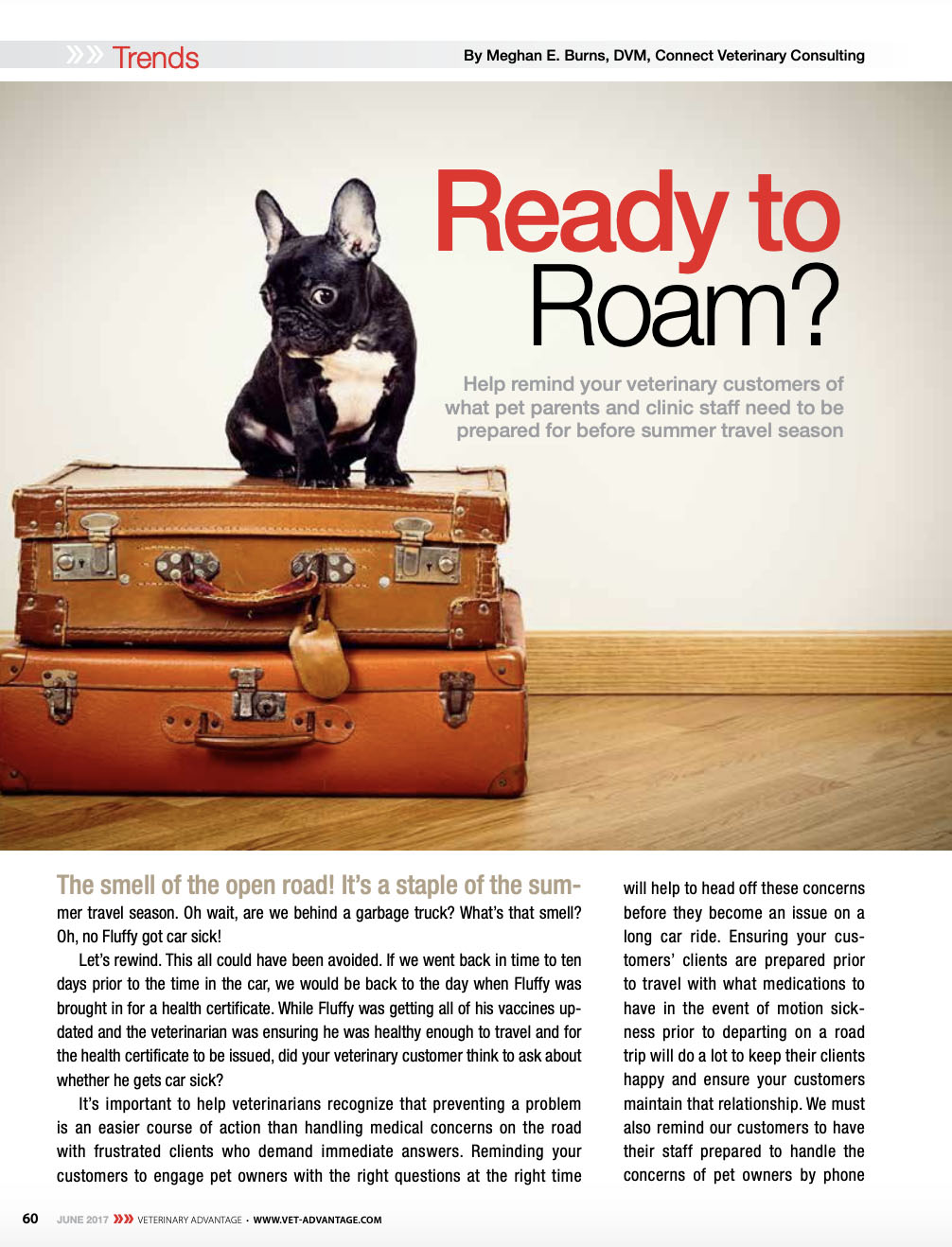
  • Pet Travel Basics: Ready to Roam?

    Pet Travel Basics: Ready to Roam?

    Help remind your veterinary customers of what pet parents and clinic staff need to be prepared for when it comes to pet travel before the summer season.

    The smell of the open road! It’s a staple of the summer travel season. Oh wait, are we behind a garbage truck? What’s that smell? Oh no, Fluffy got car sick!

    Let’s rewind. This all could have been avoided. If we went back in time to ten days prior to the time in the car, we would be back to the day when Fluffy was brought in for a health certificate. While Fluffy was getting all of his vaccines updated and the veterinarian was ensuring he was healthy enough to travel and for the health certificate to be issued, did your veterinary customer think to ask about whether he gets car sick?

    It’s important to help veterinarians recognize that preventing a problem is an easier course of action than handling medical concerns on the road with frustrated clients who demand immediate answers. Reminding your customers to engage pet owners with the right questions at the right time will help to head off these concerns before they become an issue on a

    long car ride. Ensuring your customers’ clients are prepared prior to travel with what medications to have in the event of motion sickness prior to departing on a road trip will do a lot to keep their clients happy and ensure your customers

    maintain that relationship. We must also remind our customers to have their staff prepared to handle the concerns of pet owners by phone when unexpected travel issues arise. Providing empathy, genuine concern, and solutions to your customers’ most valuable clients over the phone will go a long way to enhancing the veterinarian-client relationship.
    >> READ FULL ARTICLE

  • Heartworm Prevention: Creating a Habit

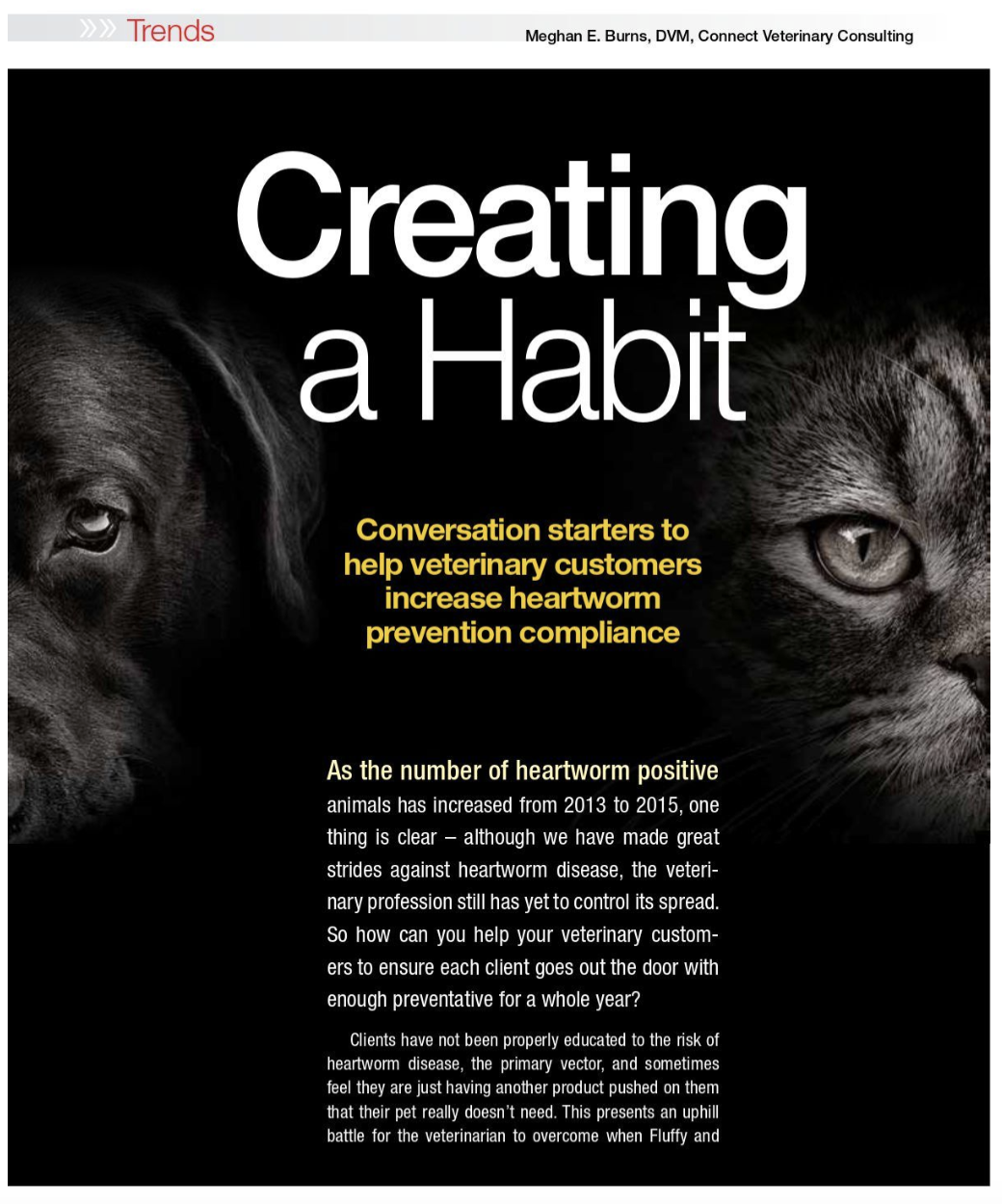
    Heartworm Prevention: Creating a Habit

    Learn more about conversation starters to help veterinary customers increase heartworm prevention compliance.

    As the number of heartworm positive animals has increased from 2013 to 2015, one thing is clear – although we have made great strides in heartworm prevention, the veterinary profession still has yet to control its spread.

    So how can you help your veterinary customers ensure each client goes out the door with enough preventative for a whole year?

    Clients have not been properly educated to the risk of heartworm disease, and sometimes feel they are just having another product pushed on them that their pet really doesn’t need. This presents an uphill battle for the veterinarian to overcome when Fluffy and Fido visit for their yearly check-up and vaccine appointment. You as a sales representative can remind the veterinarian on how to start the conversation:

    “Heartworms are a real danger and are a serious threat to both dog and cat health. This can be revealed by reviewing the lifecycle with the pet owner,” and then explain:

    • Heartworms are transmitted by mosquitoes.
    • Infected mosquitoes can come inside the home, both outdoor and indoor pets are at risk. 
    • Mosquitos become infected with microfilariae while taking a blood meal from an infected animal.
    • When the mosquito bites an animal, the infective larvae are discharged onto the surface of the animal’s skin. After the mosquito withdraws its proboscis, the infective larvae enter the animal through the bite wound.
    • Once inside a new host, it takes approximately 6 months for the larvae to mature into adult heartworms. Once mature, heartworms can live for 5 to 7 years in dogs and up to 2 or 3 years in cats. Because of the longevity of these worms, each heartworm positive pet becomes a reservoir for microfilariae to infect other pets.

    >> READ FULL ARTICLE

  • Becoming a Fear Free Practice

    The Fear Free program isn’t a tagline, but a toolbox.

    What if I told you and your veterinary customers that
    utilizing one program would allow you to increase client visits, decrease patient and client stress, decrease the potential for vet clinic staff injuries, and potentially decrease one of the most frequent causes of staff burnout? Is your first reaction, yeah right? Or show me how?

    Becoming a Fear-Free certified practice does all those things, and more.

    Veterinarians and vet nurses are an integral part to the human-animal bond. Not picking up on behavioral signs of fear erodes the joy of veterinary medicine when­ever conflict develops with patients and increases the potential for injuries. Ultimately, any and all of this puts the human-animal bond in jeopardy. Ultimately any and all of this puts the human-animal bond in jeopardy. Sixty-seven percent of licensed clinical veterinarians and 98% of veterinary nurses experience an animal-related injury at some point in their careers.[1] The reported methods of these injuries include bites, kicks, scratches, and being crushed by equipment used for animal restraint.[1] 

    Whenever possible, patient preparation before visits will help to prevent anxiety from accumulating and help alleviate stress upon arrival at the hospital.[2] The majority of cat owners report the perception of stress for their cats is the primary reason they fail to seek veterinary care.[3] A recent study shows the use of high-dose gabapentin is a safe and effective treatment for cats to help reduce stress and aggression and increase compliance for transportation and veterinary examination.[4] Appropriate use of sedation and analgesia is just one component of the Fear-FreeTMtoolbox.

    >> READ FULL ARTICLE


    [1] Nienhaus A, Skudlik C, Seidler A. Work-related accidents and occupational diseases in veterinarians and their staff. Int Arch Occup Environ Health. 2005;78:230–238.

    [2] Yin, S. Low Stress Handling, Restraint and Behavior Modification of Dogs and Cats: Techniques for Patients Who Love Their Visits; CattleDog Publishing: Davis, CA, USA, 2009.

    [3] van Haaften KA, Forsythe LRE, Stelow EA, Bain MJ. Effects of a single preappointment dose of gabapentin on signs of stress in cats during transportation and veterinary examination. J. Am. Vet. Med. Assoc. 2017 Nov 15;251(10):1175-1181.

    [4] Pankratz KE, Ferris KK, Griffith EH, Sherman BL. Use of single- dose oral gabapentin to attenuate fear responses in cage-trap confined community cats: a double-blind, placebo-controlled field trial. J Feline Med Surg. 2017. 

  • Repair the Barrier, Not Rinse and Repeat

    Using proactive therapy, help your veterinary customers with owners who aren’t compliant with shampooing as often as prescribed.

    It’s all well and good when the medicine your veterinary customers prescribe does the trick the first time around. But, when owners are not compliant with treatment instructions, skin infections don’t respond to antibiotic therapy due to underlying disease, or the ear infection recurs resulting in angry owners and a dog that is still potentially in need of further diagnostics as well as treatment. What if this could all be avoided be­fore this cycle starts?

    Proactive therapy can often be the best medicine. Here’s how it works.

    Your customers already know that atopic dermatitis (AD):

    • Affects 10 to 15 percent of the canine population
    • Itchy skin is the most common clinical sign
    • Along with redness on the face, paws, ears, and inguinal areas
    • Clinical signs in most cases are triggered by:
      • dust mites
      • pollen
      • flea/insect bites
      • food allergies

    >>READ FULL ARTICLE