Category: Published Media

  • The CVS Effect in Veterinary Medicine

    What happens when consolidation shifts bargaining power?

    Consolidation changes ownership. It also changes leverage.

    In the early stages of consolidation, labor tends to win. Signing bonuses rise. Compensation climbs. Recruiters compete aggressively. Narratives of shortage dominate.

    Veterinary medicine has been in that phase for several years.

    But consolidation follows predictable cycles. And so do labor markets.

    As consolidation increases and labor supply expands, bargaining power shifts – from clinician to operator. The shift is rarely ideological. It is arithmetic.

    We have seen this pattern before.

    When CVS Health accelerated acquisitions, it entered fragmented markets, attracted pharmacists with competitive compensation, and expanded its geographic footprint rapidly. Early on, labor leverage was strong.

    Over time, independent alternatives narrowed. Market density increased. Optionality compressed.

    Bargaining power recalibrated.

    Similarly, in vertically integrated health systems such as UnitedHealthcare – where insurance, care delivery, and infrastructure operate within a unified ecosystem – labor markets behave differently once capital controls multiple layers of the value chain.

    Veterinary medicine is not pharmacy. It is not human healthcare.


    Read the Full Analysis…

    Veterinary consolidation has reshaped the profession over the past decade, driving higher compensation, increased competition for talent, and expanded corporate investment across the industry.

    But consolidation cycles evolve. As ownership concentrates and labor supply expands, the bargaining power dynamics that fueled rapid salary growth begin to shift.

    This article explores how veterinary consolidation changes leverage within the profession—and why the durability of today’s compensation models may become a central question for operators, investors, and clinicians alike.

    >> READ FULL ARTICLE

  • Veterinary Consolidation: Shifting Salary Leverage

    Veterinary Consolidation: Shifting Salary Leverage

    Independent veterinary practices are not facing a valuation crisis.

    They are facing something more subtle—and potentially more dangerous.

    Across the industry, headline valuations remain resilient. Buyer interest persists. Capital is still available. On the surface, the market appears stable.

    Yet underneath that stability, a quieter shift is taking place—one that does not show up immediately in revenue reports, but becomes unmistakable during diligence, underwriting, and strategic review. The key risk factors include declining client retention, higher labor costs, greater earnings variability, and a changing client mix that affects margins and predictability.

    The threat is not declining demand in the abstract. The key risk lies in the deterioration of earnings quality and predictability, driven by changes in client retention, demand structure, and the efficiency with which demand is converted into durable cash flow.

    This erosion rarely announces itself. It accumulates.

    When Revenue Looks Stable but Becomes Less Reliable

    Many independent practices still report solid topline numbers. What has changed is how those numbers are generated.

    Key risk factors have emerged: visit frequency is softening, transaction values are more volatile, client mix is shifting toward higher-maintenance, lower-margin segments, labor costs are structurally higher and less flexible, and capacity constraints increasingly dictate which services can be delivered rather than strategic intent.

    None of this necessarily collapses revenue in the near term.

    But it does introduce variability—and variability is the enemy of enterprise value.From an executive perspective, the issue is not whether revenue exists today. It is whether that revenue is repeatable, transferable, and resilient under different ownership, staffing, and animal health market conditions.


    Read the Full Analysis…

    Veterinary consolidation has accelerated over the past decade, bringing capital access, operational scale, and career mobility across corporate networks. At the same time, associate compensation has risen meaningfully, driven by competition and persistent shortage narratives.

    But consolidation cycles mature. Labor markets adjust. And compensation structures that were built during high-growth acquisition phases are not always structurally durable over the long term.

    This analysis examines how veterinary consolidation reshapes bargaining power, workforce optionality, and long-term economic resilience within the profession.

    >> READ FULL ARTICLE

  • Nine Things Animal Health Start-ups Need to Know Before Pitching to Investors

    Nine Things Animal Health Start-ups Need to Know Before Pitching to Investors

    Animal health is currently witnessing exponential growth in its start-up scene, with an increasingly large number of new businesses attracted to the sector every year. Dr Meghan E Burns used her skills as a veterinarian, communicator and marketer to found Connect Veterinary Consulting – an agency dedicated to helping animal health companies stand out as industry thought leaders. She gave IHS Markit Animal Health an insight into her advice for start-ups.

    So, you have a great technology and a dream? Congratulations but, in some ways, that’s the easy part. The real challenge is making that dream a reality.

    Often, that comes down to one thing – funding. How you get it, where you get it and, for that matter, whether you get it depends largely on what you need to accomplish, how you present your opportunity and what you’ve accomplished to date.

    It has been my experience in coaching teams for various animal health or agriculture forums that a well-crafted pitch deck with the right amount of science interlaced with the right amount of financial data, realistic revenue projections and a realistic view of the regulatory path forward will help attract the investors you seek. Here are some key points in preparing for such a pitch:

    1. Get your pitch on point

    Before you get up in front of a large investment forum audience or present to a small group at a family office, investment bank or business development staff at a pharma company, you need to refine your pitch.

    While that pitch varies slightly based on your audience, all will want to know about the science supporting your technology, your current stage of development, work remaining, timeline to completion, current financing, the future investment required, potential obstacles (regulatory, financial, scientific), intellectual property protection and, of course, a realistic assessment of the size of the opportunity.

    Know who you are pitching to. An investment banker looking for equity and a profitable exit in an operating company, and a pharma company executive seeking to acquire promising but early-stage technology will be looking for different things in your pitch deck. Do you go deep with the financial data or devote 12 presentation slides to scientific detail? It depends. This is where hiring an experienced consultant to help refine the pitch deck is money well spent.

    2. It’s all in the delivery

    Of almost equal importance is pitch delivery. We have all slept through lectures and boring presentations. Make sure you are represented by an engaging, persuasive speaker who can confidently answer all questions and who can adapt the pitch to a wide range of listeners. Mark Twain with a science degree might be an ideal model.

    3. Realism versus ‘all or none’

    Be realistic about the sum of money you seek from investors and have an appropriately detailed plan for its use.

    Many start-ups naively ask for the full amount needed to complete the work required to get their product market. Unless your needs are unusually modest, that’s bound to be a daunting sum to raise in one round. Instead, it’s best to correlate financial needs with critical steps in the development process (considering, of course, the need to meet payrolls, pay rent and support the other activities that keep a company afloat).

    Do you need cash to open a file with the US FDA? Complete proof-of-concept studies? Run pivotal trials? Pay for contract manufacturing? At every stage of development, there are landmarks that are indicators of decreased risk and increased chances of success.

    So, instead of looking at all the money you need to get to the finish line, what would it take to get to the next step (or steps)? Precise ‘asks’ attract new investors and encourage current ones to fund the next round. Getting to the finish line is the goal but, as the saying goes, it’s vital to not over-reach your headlights.

    4. Don’t oversell or undersell your revenue estimates

    It’s easy to crank up your revenue estimates but pie-in-the-sky projections will send investors running for the exits. If you insist your activity-tracking dog collar will achieve $80 million sales in five years when the current total market for similar products is <$20m, investors’ eyes will likely roll.

    By the same token, don’t be unduly pessimistic. Undercutting your sales projections will, of course, also leave investors with questions. An honest appraisal of your prospects instills investors with confidence.

    5. Not diluting control and ownership

    Make sure what your investors want in return for their cash is something you can live with. Companies that desperately need money to stay afloat or reach their next milestone may be tempted to give up more equity and control than is wise. Know what you are willing to relinquish in equity before you begin to negotiate with a funding source. Act in haste and you may regret at leisure.

    6. Be realistic with your timeline to market

    Know what progress you’ve made and the distance yet to travel. Do you have encouraging proof-of-concept data? That’s great but chances are you are still many miles from the goal. Starkly evaluate what still needs to be done and don’t minimize it.

    You will be asked these questions regularly. Where are you in the approval process? Have you met with the FDA? Received approval for pivotal trial protocols? Have you evaluated CMC concerns? If not, why not? You can count on delays and setbacks. Funding sources will want to know how you plan to navigate them.

    7. Know your regulatory path

    It’s essential to know the path to market and how to leverage a relationship with the appropriate regulatory body. If the FDA regulates your product, do you have the funds necessary to open a

    New Animal Drug Application? Have you met with the agency or are you merely guessing about what will be needed for approval?

    Don’t underestimate how complex, lengthy and expensive the arduous path to approval will likely be. The facts may be hard to face but wise investors will be aware of them and will expect you to recognize them too in your pitch.

    8. De-risk, de-risk and de-risk

    The more de-risked your product is, the better.

    Solid data, progress to date, market potential and a talented management team all help win investors’ hearts and wallets. So, it’s essential to look for any reasonably fast and inexpensive steps you can take to bolster investor confidence.

    Will a second, more robust proof-of-concept trials show unequivocally that your compound is effective or safe? Will the addition of a trusted, veteran industry professional to your board build confidence? Are there additional product indications that you can target to expand your revenue potential?

    9. Know your unique selling proposition

    It’s critical that your pitch underscores your unique selling proposition (USP). Surprisingly, many start-ups and even early-stage operating companies, don’t understand (read point four) their potential competition, the potential demand for their product and how any differentiation they bring to a given category will or will not drive sales.

    Can you compete and win on price, form factor, innovative mode of action, safety, efficacy, flavor, and convenience? Whatever your advantage may be, have a concise and robust USP at the ready for investor meetings. Interrogate your product until it confesses its strengths.

    >> READ FULL ARTICLE
  • The Latest in Treating Canine Lymphoma

    The Latest in Treating Canine Lymphoma

    Chemotherapy, antibody therapy and immunotherapy continue to provide hope for canine lymphoma.

    Everybody reading this article has likely had their life touched by cancer, either personally or through a friend, family member, or beloved pet. Cancer is something we all want to eradicate.

    While a complete cure may prove unachievable, making the disease more manageable is possible with the new technologies and advancements coming to the field of canine lymphoma.

    Why The Type Matters

    Canine lymphomas are a diverse group and among the most commonly diagnosed cancers in dogs. They collectively represent from 7 to 24 percent of all cancers diagnosed in dogs, according to the National Canine Cancer Foundation.

    More than 30 types of canine lymphoma have been described, and each can vary tremendously in its behavior. Some progress rapidly and are acutely life-threatening without treatment, while others advance slowly and are managed as chronic diseases.

    Lymphomas may affect any organ in the body, but they most commonly originate in lymph nodes before spreading to organs such as the spleen, liver, and bone marrow.

    >> READ FULL ARTICLE

  • How to Keep Pet Joint Pain at Bay

    How to Keep Pet Joint Pain at Bay

    What you need to know about prevention and management of pet joint pain, or osteoarthritis in cats and dogs.

    Owners often bring their pets to their veterinarian when they notice their companions are no longer as active as they once were. These dogs and cats often overweight by the time they present to their veterinarian. If the diagnosis is osteoarthritis, the goal is to prevent any ongoing discomfort for pets. Often, owners ask if there was anything that could have been done to prevent it.

    Certain breeds of dogs are predisposed to osteoarthritis (OA). Yet there are ways to help keep pet joint pain at bay and delay the onset of clinical signs in those breeds. Every veterinarian you ask about OA, regardless of specialty, will respond with the same no. 1 answer to preventing or delaying the onset of clinical symptoms of OA.

    “The most important part of preventing the clinical signs associated with osteoarthritis is weight management and maintaining an ideal body weight,” said Martha Cline, DVM, Dipl. ACVN, a board-
    certified veterinary nutritionist from Red Bank Veterinary Hospital in New Jersey.

    In studies, obese dogs with OA have shown noticeable improvement even with only a 6.10-8.85 percent reduction in body weight.

    Controlled activity is another way to prevent injury that leads to OA. Leash walks or jogging/trotting with pets help improve joint nutrition and assist in keeping the ligaments and cartilage healthy.

    “When joints are healthy, they are less likely to incur injury with explosive activity,” said Michael Conzemius, DVM, Ph.D., Dipl. ACVS of the University of Minnesota.

    Dietary supplements also have been shown to help maintain joint nutrition. Omega-3 fatty acids, such as EPA and DHA, help mediate the inflammatory response in joints.2 Glucosamine and chondroitin sulfate are commonly found in joint supplements for pets. It’s truly buyer beware with any of these products. Nutraceuticals such as joint supplements are not FDA-regulated, and more objective, randomized clinical trials that investigate the effect of specific components of these supplements need to be performed.

    >> READ FULL ARTICLE

  • The Latest on Veterinary Cardiology

    The Latest on Veterinary Cardiology

    How the advances in veterinary cardiology and canine medicine improve heart health for the lives of patients.

    Veterinary medicine has come a long way in recent years, especially in veterinary cardiology, where a large volume of research is underway.

    Researchers and specialists are making strides in interventional cardiology, which uses advanced procedures and imaging techniques to perform minimally invasive therapy with certain cardiac diseases. It can be used to correct abnormal rhythms or close openings in the heart.

    An example of the latter is called patent ductus arteriosus, or PDA. The condition results from failure of the ductus arteriosus to close after birth, resulting in an irregular flow of blood from the aorta to the main pulmonary artery.

    One minimally invasive treatment option utilizes the Amplatz Canine Duct Occulder, a device delivered via the vasculature by a catheter to the site of the PDA.

    Thaibinh Nguyenba, DVM, Dipl. ACVIM (cardiology), of MedVet Medical and Cancer Centers for Pets in Columbus, Ohio, was one of the technique’s lead researchers. He calls the Amplatz Canine Duct Occulder, or ACDO, a significant advancement in veterinary interventional cardiology.

    “[It] infuses novel biotechnology into a cardiovascular device designed specifically for dogs,” Dr. Nguyenba said. “With this device and procedure, patent ductus arteriosus occlusion success rates in dogs match those seen in similar procedures for people with the same disease.

    “Within a decade of its development, this minimally invasive procedure has become the treatment of choice for correcting patent ductus arteriosus in dogs,” he added.

    >> READ FULL ARTICLE

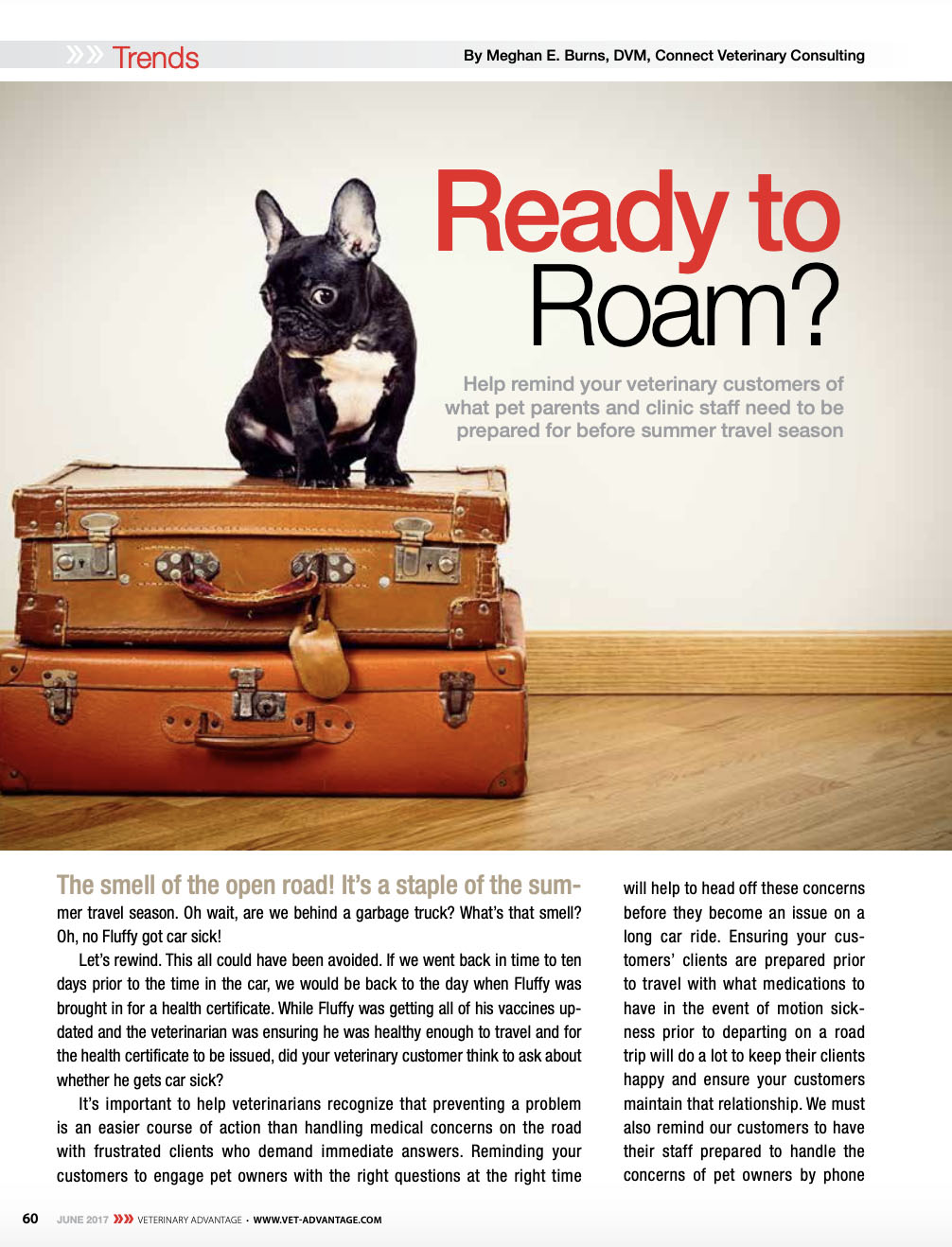
  • Pet Travel Basics: Ready to Roam?

    Pet Travel Basics: Ready to Roam?

    Help remind your veterinary customers of what pet parents and clinic staff need to be prepared for when it comes to pet travel before the summer season.

    The smell of the open road! It’s a staple of the summer travel season. Oh wait, are we behind a garbage truck? What’s that smell? Oh no, Fluffy got car sick!

    Let’s rewind. This all could have been avoided. If we went back in time to ten days prior to the time in the car, we would be back to the day when Fluffy was brought in for a health certificate. While Fluffy was getting all of his vaccines updated and the veterinarian was ensuring he was healthy enough to travel and for the health certificate to be issued, did your veterinary customer think to ask about whether he gets car sick?

    It’s important to help veterinarians recognize that preventing a problem is an easier course of action than handling medical concerns on the road with frustrated clients who demand immediate answers. Reminding your customers to engage pet owners with the right questions at the right time will help to head off these concerns before they become an issue on a

    long car ride. Ensuring your customers’ clients are prepared prior to travel with what medications to have in the event of motion sickness prior to departing on a road trip will do a lot to keep their clients happy and ensure your customers

    maintain that relationship. We must also remind our customers to have their staff prepared to handle the concerns of pet owners by phone when unexpected travel issues arise. Providing empathy, genuine concern, and solutions to your customers’ most valuable clients over the phone will go a long way to enhancing the veterinarian-client relationship.

    >> READ FULL ARTICLE

  • Heartworm Prevention: Creating a Habit

    Heartworm Prevention: Creating a Habit

    Learn more about conversation starters to help veterinary customers increase heartworm prevention compliance.

    As the number of heartworm positive animals has increased from 2013 to 2015, one thing is clear – although we have made great strides in heartworm prevention, the veterinary profession still has yet to control its spread.

    So how can you help your veterinary customers ensure each client goes out the door with enough preventative for a whole year?

    Clients have not been properly educated to the risk of heartworm disease, and sometimes feel they are just having another product pushed on them that their pet really doesn’t need. This presents an uphill battle for the veterinarian to overcome when Fluffy and Fido visit for their yearly check-up and vaccine appointment. You as a sales representative can remind the veterinarian on how to start the conversation:

    “Heartworms are a real danger and are a serious threat to both dog and cat health. This can be revealed by reviewing the lifecycle with the pet owner,” and then explain:

    • Heartworms are transmitted by mosquitoes.
    • Infected mosquitoes can come inside the home, both outdoor and indoor pets are at risk. 
    • Mosquitos become infected with microfilariae while taking a blood meal from an infected animal.
    • When the mosquito bites an animal, the infective larvae are discharged onto the surface of the animal’s skin. After the mosquito withdraws its proboscis, the infective larvae enter the animal through the bite wound.
    • Once inside a new host, it takes approximately 6 months for the larvae to mature into adult heartworms. Once mature, heartworms can live for 5 to 7 years in dogs and up to 2 or 3 years in cats. Because of the longevity of these worms, each heartworm positive pet becomes a reservoir for microfilariae to infect other pets.

    >> READ FULL ARTICLE

  • Becoming a Fear Free Practice

    The Fear Free program isn’t a tagline, but a toolbox.

    What if I told you and your veterinary customers that
    utilizing one program would allow you to increase client visits, decrease patient and client stress, decrease the potential for vet clinic staff injuries, and potentially decrease one of the most frequent causes of staff burnout? Is your first reaction, yeah right? Or show me how?

    Becoming a Fear-Free certified practice does all those things, and more.

    Veterinarians and vet nurses are an integral part to the human-animal bond. Not picking up on behavioral signs of fear erodes the joy of veterinary medicine when­ever conflict develops with patients and increases the potential for injuries. Ultimately, any and all of this puts the human-animal bond in jeopardy. Ultimately any and all of this puts the human-animal bond in jeopardy. Sixty-seven percent of licensed clinical veterinarians and 98% of veterinary nurses experience an animal-related injury at some point in their careers.[1] The reported methods of these injuries include bites, kicks, scratches, and being crushed by equipment used for animal restraint.[1] 

    Whenever possible, patient preparation before visits will help to prevent anxiety from accumulating and help alleviate stress upon arrival at the hospital.[2] The majority of cat owners report the perception of stress for their cats is the primary reason they fail to seek veterinary care.[3] A recent study shows the use of high-dose gabapentin is a safe and effective treatment for cats to help reduce stress and aggression and increase compliance for transportation and veterinary examination.[4] Appropriate use of sedation and analgesia is just one component of the Fear-FreeTMtoolbox.

    >> READ FULL ARTICLE


    [1] Nienhaus A, Skudlik C, Seidler A. Work-related accidents and occupational diseases in veterinarians and their staff. Int Arch Occup Environ Health. 2005;78:230–238.

    [2] Yin, S. Low Stress Handling, Restraint and Behavior Modification of Dogs and Cats: Techniques for Patients Who Love Their Visits; CattleDog Publishing: Davis, CA, USA, 2009.

    [3] van Haaften KA, Forsythe LRE, Stelow EA, Bain MJ. Effects of a single preappointment dose of gabapentin on signs of stress in cats during transportation and veterinary examination. J. Am. Vet. Med. Assoc. 2017 Nov 15;251(10):1175-1181.

    [4] Pankratz KE, Ferris KK, Griffith EH, Sherman BL. Use of single- dose oral gabapentin to attenuate fear responses in cage-trap confined community cats: a double-blind, placebo-controlled field trial. J Feline Med Surg. 2017. 

  • Repair the Barrier, Not Rinse and Repeat

    Using proactive therapy, help your veterinary customers with owners who aren’t compliant with shampooing as often as prescribed.

    It’s all well and good when the medicine your veterinary customers prescribe does the trick the first time around. But, when owners are not compliant with treatment instructions, skin infections don’t respond to antibiotic therapy due to underlying disease, or the ear infection recurs resulting in angry owners and a dog that is still potentially in need of further diagnostics as well as treatment. What if this could all be avoided be­fore this cycle starts?

    Proactive therapy can often be the best medicine. Here’s how it works.

    Your customers already know that atopic dermatitis (AD):

    • Affects 10 to 15 percent of the canine population
    • Itchy skin is the most common clinical sign
    • Along with redness on the face, paws, ears, and inguinal areas
    • Clinical signs in most cases are triggered by:
      • dust mites
      • pollen
      • flea/insect bites
      • food allergies

    >>READ FULL ARTICLE